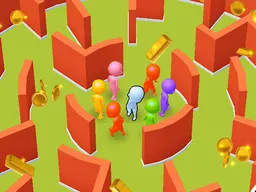
Just One Reason to Play This Free Basketball Arcade Game
Just One is a free arcade basketball game you play directly in your browser on desktop and mobile, where you shoot free throws by choosing the perfect power and angle with a single throw. Bounce the ball off walls, chain combos together, and climb the scoreboard in this simple but challenging skill-based game.
About the Game
Just One strips away the complexity of traditional basketball games and focuses on what matters: landing your shot. You get exactly one throw per round, and everything depends on how well you read the court. The ball bounces off walls, giving you multiple paths to the basket. Nail the angle and power, and you score. Miss the timing, and you start over. The game runs smoothly in your browser on any device, from laptop to phone, with no installation needed. Each session is short enough to play while waiting for something, but challenging enough to keep you coming back. The abstract visual style keeps the focus on the physics and your decision-making rather than flashy graphics. As you improve, you'll start seeing angles you missed before, discovering how the walls can work with your shot instead of against it. The scoring system rewards accuracy and consistency, so every throw matters.
How to Play
The core loop is straightforward: aim your shot, choose how hard to throw, and watch what happens. You stand at one end of the court with the basket ahead of you. Before each shot, you adjust your angle and the power of your throw. The game gives you visual feedback as you line things up, so you can predict roughly where the ball will go. Once you release, physics takes over. The ball travels across the court, potentially bouncing off the walls you see on screen. If it goes in, you score points and move to the next shot. If it misses, your turn ends. The challenge comes from learning how much power is too much, when a wall bounce helps instead of hurts, and how the court layout changes your approach. Early attempts often result in balls flying out of bounds or rolling past the basket. But as you play, you start to sense the rhythm. You realize some angles are safer, others offer higher rewards. Combo shots, where you chain successful throws together, give you bonus points, so consistency becomes a strategy. The game doesn't rush you between attempts, so you have time to think before each throw.
Controls
The controls are built around one action: aiming and shooting. On desktop with a mouse, you move your cursor to set the angle of your shot, then click to release the ball with a specific power level. The timing and position of your click determine how hard the throw goes. On mobile devices with touch, you tap and drag your finger across the screen to aim, then release to shoot. The longer your drag motion, the more power goes into the throw. Both methods feel natural after a couple of attempts, though touch players often find the drag mechanic more intuitive because you can feel the motion building up. There's no sprint button, no special moves to activate, no menu systems to navigate mid-game. Just aim, power, and release. This simplicity is the game's strength, especially on mobile where screen space matters.
Tips to Score More
Your first instinct will be to throw hard, but power isn't everything. Many players waste their first five attempts learning that a softer touch sometimes works better, especially when the basket is close. The walls exist to help you, not trap you. Before you throw, trace an imaginary line from your ball to the basket. Does a wall sit in the way? Instead of going straight, try banking the shot off that wall at an angle. These bounce shots take practice, but they often open up scoring opportunities that direct throws can't reach. Consistency matters more than lucky long shots. If you can make the same shot type work five times in a row, you're building a combo, and combos multiply your score. Focus on shots you understand rather than attempting every possible angle. Watch what happens when you use the same power level several times. You'll start to predict where the ball lands. Most players improve fastest by picking one shot type, mastering it, then expanding their range. Don't get frustrated if your first few games feel random. The physics engine is fair; you just need to learn its rules.
Advanced Moves
Once you've landed basic shots, the game opens up. The most effective advanced technique is the wall-bank combo, where you deliberately bounce off multiple walls to reach angles that seem impossible. This requires reading the court quickly and understanding how the ball reacts to each surface. A secondary technique involves power management. You'll notice that different baskets reward different throw speeds. Some are designed for fast, direct shots. Others only become accessible with slower throws that let gravity work longer. Skilled players develop a feel for these distinctions and adjust their power mid-session based on the basket position. Finally, rhythm plays a role. Players who develop a steady pace, taking roughly the same time between shots, often perform better than those who rush or overthink. This isn't accidental; it trains your muscle memory so your throws become more consistent. Once you hit this flow state, your score climbs faster than you'd expect.
Modes and Stages
Just One keeps the focus tight by avoiding excessive menu systems. Your score accumulates as you complete successful shots. The game progresses by increasing difficulty rather than dividing into named stages or levels. Each session presents a fresh court with the basket positioned differently, forcing you to adapt. Some positions are punishing; others offer safer scoring opportunities. The game doesn't lock you behind achievements or require unlocks to access new content. You play, you score, you improve. The simplicity is intentional. Rather than chasing different game modes, you're chasing your personal best, and that goal is powerful enough to bring players back repeatedly. Leaderboard tracking, if present, shows you how your high score compares across sessions.
For Whom Is This Game
Just One appeals to players who enjoy skill-based challenges without complex rules. If you loved games like Flappy Bird or Super Hexagon, where a simple mechanic rewards precision and timing, you'll recognize the satisfaction here. Basketball fans enjoy it because it captures the essence of free-throw shooting without simulation bloat. Mobile gamers appreciate it because a session can end whenever you're done; there's no waiting for timers or energy bars. It's perfect for short breaks or extended play. Casual players find it accessible because the first few throws teach you everything you need to know. Hardcore players find it rewarding because mastering the physics and developing reliable shot patterns takes genuine practice. The game doesn't discriminate by age or gaming background. Anyone with a web browser and a few minutes can start playing immediately. There's no learning curve so steep it discourages new players, and there's no ceiling so low that veterans get bored.
Controls
Keyboard and mouse
- Move mouse to adjust aim angle
- Click to shoot (timing and click distance affect power)
- Release to confirm shot
Touch
- Tap and drag finger to aim
- Drag distance determines shot power
- Release finger to shoot
FAQ
- Is this game really free and do I need to download anything?
- Yes, Just One is completely free to play in your web browser. There's nothing to download or install. Just visit the page and start playing immediately on any device with a modern browser.
- Does Just One work on my phone?
- Absolutely. The game is designed for both desktop and mobile screens. It plays smoothly on phones and tablets using touch controls. The game automatically adjusts to your screen size, so you get the same experience whether you're on a large monitor or a smartphone.
- What happens when I miss a shot?
- When you miss, your turn ends and your combo resets. You don't lose points or face penalties; your score just stops growing until you make the next shot. The game gives you unlimited attempts, so missing is a learning opportunity, not a failure state.
- How does the bounce mechanic work exactly?
- When your ball hits a wall during flight, it rebounds at a realistic angle based on the direction you threw it and the wall's position. The game uses physics simulation, so the same throw from the same position will produce the same result every time. Learning to predict and use bounces is key to improving your score.
- Can I play this against other people?
- Just One is a single-player game focused on beating your own high score. There's no multiplayer mode, but you can challenge friends by comparing scores and seeing who can achieve the highest streak or total points.
- Does the difficulty increase as my score goes up?
- The game adjusts by changing the basket position after each successful shot. Easier positions might appear early to let you build confidence, while more challenging angles show up later. Your score reflects how many shots you can land in a row, so difficulty is self-adjusting based on your skill level.
- Why do some of my throws feel inconsistent?
- Power and angle are both critical. If you're using the same angle but your power delivery varies slightly, the ball will land in different places. This is actually a feature, not a bug. The inconsistency teaches you to be precise with both elements. Once you develop a steady throwing style, your results become much more predictable.
- Is there a best strategy for improving my score?
- Focus on mastering one or two shot types before expanding your range. Build your combos by making the same shot repeatedly, since consistency matters more than variety. As you improve, experiment with wall bounces and different power levels. Most players see rapid improvement by sticking to reliable shots rather than attempting risky angles.